

You are using an out of date browser. It may not display this or other websites correctly.
You should upgrade or use an alternative browser.
You should upgrade or use an alternative browser.
Mid-Acts Presentations
- Thread starter Right Divider
- Start date
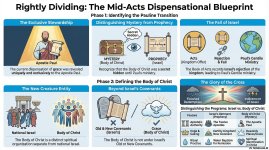

In reference to the bottom right square in that presentation, and specifically in regard to the issue of water baptism, it seems to me that if a person approaches Paul’s epistles without importing a large theological framework beforehand, it is very difficult to conclude that water baptism is forbidden for members of the Body of Christ, as many Mid-Acts believers teach.
That does not mean that baptism is required. It certainly is not part of the gospel of grace, and Paul himself goes out of his way to distinguish the two. In I Corinthians 1:17 he says plainly, “Christ did not send me to baptize, but to preach the gospel.” That statement alone is enough to remove baptism from the category of saving ordinances. Salvation is through faith in Christ alone.
At the same time, that passage does not condemn the practice. In the very same context Paul acknowledges that he personally baptized Crispus, Gaius, and the household of Stephanas. His concern in that chapter is not that baptizing them was wrong, but that the Corinthians were dividing themselves into factions based on who baptized whom. In other words, Paul corrects their misuse of the practice without ever suggesting that the practice itself was sinful or illegitimate.
That observation matters because Paul is not shy about correcting things that should not be happening in the churches. When the Corinthians abused spiritual gifts, he corrected them. When they tolerated sexual immorality, he corrected them. When they distorted the Lord’s Supper, he corrected them. Yet nowhere in his epistles do we find an instruction telling believers to stop baptizing people.
Paul also speaks of baptism positively in several places. Romans 6 uses baptism imagery to describe union with Christ in His death and resurrection. Colossians 2 does the same thing. Whether one ultimately understands those passages to refer to Spirit baptism or not, the point remains that Paul employs the language constructively, not polemically.
For that reason it should not surprise us that many sincere believers read Paul and conclude that water baptism may still be practiced as a symbolic expression of faith, even if it is not required for salvation and not central to the gospel message.
From a Mid-Acts perspective we rightly insist that the gospel of the grace of God is faith in Christ apart from works, ordinances, or rituals. On that point there should be no compromise. Baptism does not save, does not cleanse sin, and does not add anything to the finished work of Christ.
However, recognizing that baptism is unnecessary for salvation does not automatically require the conclusion that the practice itself is forbidden.
A Mid-Acts believer could reasonably say something like this:
Paul clearly separates baptism from the gospel.
Paul personally baptized some believers.
Paul never commands believers to stop baptizing.
Paul occasionally uses baptism language positively in his teaching.
Given those facts, one could defensibly conclude that practicing water baptism as a voluntary symbol of identification with Christ is permissible, even if it is not required and carries no saving significance.
In other words, insisting that baptism is necessary would contradict Paul, but insisting that baptism is forbidden goes beyond what Paul actually says.
For those reasons, it seems to me that a Mid-Acts believer could reasonably hold that water baptism is unnecessary, non-saving, and secondary, yet still allowable as a symbolic act for those who wish to practice it.
That does not mean that baptism is required. It certainly is not part of the gospel of grace, and Paul himself goes out of his way to distinguish the two. In I Corinthians 1:17 he says plainly, “Christ did not send me to baptize, but to preach the gospel.” That statement alone is enough to remove baptism from the category of saving ordinances. Salvation is through faith in Christ alone.
At the same time, that passage does not condemn the practice. In the very same context Paul acknowledges that he personally baptized Crispus, Gaius, and the household of Stephanas. His concern in that chapter is not that baptizing them was wrong, but that the Corinthians were dividing themselves into factions based on who baptized whom. In other words, Paul corrects their misuse of the practice without ever suggesting that the practice itself was sinful or illegitimate.
That observation matters because Paul is not shy about correcting things that should not be happening in the churches. When the Corinthians abused spiritual gifts, he corrected them. When they tolerated sexual immorality, he corrected them. When they distorted the Lord’s Supper, he corrected them. Yet nowhere in his epistles do we find an instruction telling believers to stop baptizing people.
Paul also speaks of baptism positively in several places. Romans 6 uses baptism imagery to describe union with Christ in His death and resurrection. Colossians 2 does the same thing. Whether one ultimately understands those passages to refer to Spirit baptism or not, the point remains that Paul employs the language constructively, not polemically.
For that reason it should not surprise us that many sincere believers read Paul and conclude that water baptism may still be practiced as a symbolic expression of faith, even if it is not required for salvation and not central to the gospel message.
From a Mid-Acts perspective we rightly insist that the gospel of the grace of God is faith in Christ apart from works, ordinances, or rituals. On that point there should be no compromise. Baptism does not save, does not cleanse sin, and does not add anything to the finished work of Christ.
However, recognizing that baptism is unnecessary for salvation does not automatically require the conclusion that the practice itself is forbidden.
A Mid-Acts believer could reasonably say something like this:
Paul clearly separates baptism from the gospel.
Paul personally baptized some believers.
Paul never commands believers to stop baptizing.
Paul occasionally uses baptism language positively in his teaching.
Given those facts, one could defensibly conclude that practicing water baptism as a voluntary symbol of identification with Christ is permissible, even if it is not required and carries no saving significance.
In other words, insisting that baptism is necessary would contradict Paul, but insisting that baptism is forbidden goes beyond what Paul actually says.
For those reasons, it seems to me that a Mid-Acts believer could reasonably hold that water baptism is unnecessary, non-saving, and secondary, yet still allowable as a symbolic act for those who wish to practice it.
Right Divider
Body part
While the argument for "permissibility" seeks a middle ground, a consistent Mid-Acts Pauline perspective suggests that continuing water baptism—even as a symbol—undermines the very revelation it intends to honor.In reference to the bottom right square in that presentation, and specifically in regard to the issue of water baptism, it seems to me that if a person approaches Paul’s epistles without importing a large theological framework beforehand, it is very difficult to conclude that water baptism is forbidden for members of the Body of Christ, as many Mid-Acts believers teach.
That does not mean that baptism is required. It certainly is not part of the gospel of grace, and Paul himself goes out of his way to distinguish the two. In I Corinthians 1:17 he says plainly, “Christ did not send me to baptize, but to preach the gospel.” That statement alone is enough to remove baptism from the category of saving ordinances. Salvation is through faith in Christ alone.
At the same time, that passage does not condemn the practice. In the very same context Paul acknowledges that he personally baptized Crispus, Gaius, and the household of Stephanas. His concern in that chapter is not that baptizing them was wrong, but that the Corinthians were dividing themselves into factions based on who baptized whom. In other words, Paul corrects their misuse of the practice without ever suggesting that the practice itself was sinful or illegitimate.
That observation matters because Paul is not shy about correcting things that should not be happening in the churches. When the Corinthians abused spiritual gifts, he corrected them. When they tolerated sexual immorality, he corrected them. When they distorted the Lord’s Supper, he corrected them. Yet nowhere in his epistles do we find an instruction telling believers to stop baptizing people.
Paul also speaks of baptism positively in several places. Romans 6 uses baptism imagery to describe union with Christ in His death and resurrection. Colossians 2 does the same thing. Whether one ultimately understands those passages to refer to Spirit baptism or not, the point remains that Paul employs the language constructively, not polemically.
For that reason it should not surprise us that many sincere believers read Paul and conclude that water baptism may still be practiced as a symbolic expression of faith, even if it is not required for salvation and not central to the gospel message.
From a Mid-Acts perspective we rightly insist that the gospel of the grace of God is faith in Christ apart from works, ordinances, or rituals. On that point there should be no compromise. Baptism does not save, does not cleanse sin, and does not add anything to the finished work of Christ.
However, recognizing that baptism is unnecessary for salvation does not automatically require the conclusion that the practice itself is forbidden.
A Mid-Acts believer could reasonably say something like this:
Paul clearly separates baptism from the gospel.
Paul personally baptized some believers.
Paul never commands believers to stop baptizing.
Paul occasionally uses baptism language positively in his teaching.
Given those facts, one could defensibly conclude that practicing water baptism as a voluntary symbol of identification with Christ is permissible, even if it is not required and carries no saving significance.
In other words, insisting that baptism is necessary would contradict Paul, but insisting that baptism is forbidden goes beyond what Paul actually says.
For those reasons, it seems to me that a Mid-Acts believer could reasonably hold that water baptism is unnecessary, non-saving, and secondary, yet still allowable as a symbolic act for those who wish to practice it.
The "One Baptism" Constraint
The most significant hurdle for the "permissible" view is Ephesians 4:5, which states there is "one baptism". If a believer maintains that they have been spiritually baptized into the Body of Christ (the substance) but also chooses to undergo water baptism (the symbol), they are functionally practicing two baptisms.In the Dispensation of Grace, the focus shifts from the "shadows" of the law to the "substance" of Christ. To maintain a symbolic ritual is to keep one foot in the prophetic program of Israel, where water was a requirement for ritual cleanliness and national priesthood.
1 Corinthians 1:17 is a Positive Exclusion
The text argues that Paul’s statement, "Christ sent me not to baptize," is not a condemnation. However, from a Mid-Acts view, this is seen as a positive command defining the scope of the new dispensation.- Paul isn't just saying baptism is "secondary"; he is saying it is not part of his commission.
- He expresses relief and thanks God that he did not baptize more people. If the practice were a helpful, permissible symbol of identification, it would be strange for an Apostle to be "thankful" he didn't facilitate it more often.
Optimization for Clarity
The argument suggests that if baptism isn't "forbidden," it should be "allowable." However, the goal of the Mid-Acts ministry is optimizing for the clarity of the Gospel.- Water baptism, by its very nature, suggests a human work or a ritual requirement.
- In a world where millions believe water is necessary for salvation, practicing it "symbolically" creates a ministerial problem and causes unnecessary confusion.
- If the Cross is the power, and the Spirit baptism is the reality, adding water is a "distraction" that risks making the Cross of Christ of "none effect" by shifting the focus back to a physical act.
Romans 6 and Colossians 2: Substance over Symbol
The provided text suggests Paul uses baptismal language "constructively." A stricter Mid-Acts reading argues that Paul is redefining the term entirely.- In Romans 6, the "baptism" produces a literal death to sin and a new life. Water cannot do this; only the Spirit can.
- By using the word "baptism" to describe a spiritual operation, Paul is showing the believer that they have the real thing, rendering the water (the ritual) obsolete.
Conclusion: While water baptism may not be a "sin," it is doctrinally inconsistent with the unique revelation given to Paul. To practice it is to obscure the "one baptism" of the Spirit and to cling to a transitional ritual that Paul himself eventually moved past.
I've heard all of those arguments many time before and they are compelling to a degree but not fully persuasive. At the end of the day, Paul himself was baptized in water as virtually the first act of his own faith and then proceeded to personally water baptize several people. And even if he later dropped the practice, he never explicitly forbids it. It would seem then that the thrust of the above argument would mean that Paul undermined his own ministry by not only practicing the ritual and recording himself as having done so but then never clearly explaining that he had done so in error and that they practice should be ended. Talk about causing unnecessary confusion.While the argument for "permissibility" seeks a middle ground, a consistent Mid-Acts Pauline perspective suggests that continuing water baptism—even as a symbol—undermines the very revelation it intends to honor.
The "One Baptism" Constraint
The most significant hurdle for the "permissible" view is Ephesians 4:5, which states there is "one baptism". If a believer maintains that they have been spiritually baptized into the Body of Christ (the substance) but also chooses to undergo water baptism (the symbol), they are functionally practicing two baptisms.
In the Dispensation of Grace, the focus shifts from the "shadows" of the law to the "substance" of Christ. To maintain a symbolic ritual is to keep one foot in the prophetic program of Israel, where water was a requirement for ritual cleanliness and national priesthood.
1 Corinthians 1:17 is a Positive Exclusion
The text argues that Paul’s statement, "Christ sent me not to baptize," is not a condemnation. However, from a Mid-Acts view, this is seen as a positive command defining the scope of the new dispensation.
- Paul isn't just saying baptism is "secondary"; he is saying it is not part of his commission.
- He expresses relief and thanks God that he did not baptize more people. If the practice were a helpful, permissible symbol of identification, it would be strange for an Apostle to be "thankful" he didn't facilitate it more often.
Optimization for Clarity
The argument suggests that if baptism isn't "forbidden," it should be "allowable." However, the goal of the Mid-Acts ministry is optimizing for the clarity of the Gospel.
- Water baptism, by its very nature, suggests a human work or a ritual requirement.
- In a world where millions believe water is necessary for salvation, practicing it "symbolically" creates a ministerial problem and causes unnecessary confusion.
- If the Cross is the power, and the Spirit baptism is the reality, adding water is a "distraction" that risks making the Cross of Christ of "none effect" by shifting the focus back to a physical act.
Romans 6 and Colossians 2: Substance over Symbol
The provided text suggests Paul uses baptismal language "constructively." A stricter Mid-Acts reading argues that Paul is redefining the term entirely.
- In Romans 6, the "baptism" produces a literal death to sin and a new life. Water cannot do this; only the Spirit can.
- By using the word "baptism" to describe a spiritual operation, Paul is showing the believer that they have the real thing, rendering the water (the ritual) obsolete.
There's more to say, particularly about that last point you make but I'm out of time.