annabenedetti
like marbles on glass
Supreme Court upholds birthright citizenship, rejecting Trump’s proposed limits
The Supreme Court has upheld a broad conception of birthright citizenship, rejecting President Donald Trump’s executive order declaring that children born to people in the United States illegally or temporarily are not American citizens.
WASHINGTON (AP) — A divided Supreme Court on Tuesday upheld a broad conception of birthright citizenship, rejecting President Donald Trump’s executive order declaring that children born to people who are in the United States illegally or temporarily are not American citizens.
By a 6-3 vote, the court struck down Trump’s order. A bare majority of five justices, in an opinion written by Chief Justice John Roberts, held that the long-settled understanding of the 14th Amendment, adopted after the Civil War, makes a citizen of anyone born in the country, with very limited exceptions,
“Citizenship, then and now, was the right to have rights—to freely participate in our political community. The Framers of the Fourteenth Amendment extended that promise to ‘every free-born person in this land,’” Chief Justice John Roberts wrote for the court, citing congressional debate over the amendment, “We keep that promise today.”
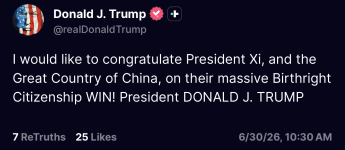
Should have been a unanimous verdict.

June 30, 2026
On January 20, 2025, the day he took the oath of office a second time, President Donald J.
 heathercoxrichardson.substack.com
The Fourteenth Amendment that established birthright citizenship came out of a very specific moment and addressed a specific problem. After the Civil War ended in 1865, former Confederates in the American South denied their Black neighbors basic rights. To remedy the problem, the Republican Congress passed a civil rights bill in 1866 establishing "[t]hat all persons born in the United States and not subject to any foreign power, excluding Indians, not taxed, are hereby declared to be citizens of the United States; and such citizens of every race and color…shall have the same right in every state and territory in the United States."
But President Andrew Johnson, who was a southern Democrat elected in 1864 on a union ticket with President Abraham Lincoln, a Republican, vetoed the 1866 Civil Rights Bill. While the Republican Party organized in the 1850s to fight the idea that there should be different classes of Americans based on race, Democrats tended to support racial discrimination. In that era, not only Black Americans, but also Irish, Chinese, Mexican, and Indigenous Americans, faced discriminatory state laws.
In contrast to the Democrats, Republicans stated explicitly in their 1860 platform that they were “opposed to any change in our naturalization laws or any state legislation by which the rights of citizens hitherto accorded to immigrants from foreign lands shall be abridged or impaired; and in favor of giving a full and efficient protection to the rights of all classes of citizens, whether native or naturalized, both at home and abroad.”
When Republicans tried to enshrine civil rights into federal law in 1866, Johnson objected that the proposed law “comprehends the Chinese of the Pacific States, Indians subject to taxation, the people called Gipsies, as well as the entire race designated as blacks” as citizens, and he noted that if “all persons who are native-born already are, by virtue of the Constitution, citizens of the United States, the passage of the pending bill cannot be necessary to make them such.” And if they weren’t already citizens, he wrote, Congress should not pass a law “to make our entire colored population and all other excepted classes citizens of the United States” when eleven southern states were not represented in Congress.
When Congress wrote the Fourteenth Amendment to the Constitution, it took Johnson’s admonition to heart. It did not confer citizenship on the groups Johnson outlined; it simply acknowledged that the Constitution had already established their citizenship. The first sentence of the Fourteenth Amendment reads: “All persons born or naturalized in the United States, and subject to the jurisdiction thereof, are citizens of the United States and of the State wherein they reside.”