Constitutional Monarchy

Clete

Truth Smacker
Silver Subscriber
TL;DR: "A removal mechanism controlled by the king cannot restrain him. A removal mechanism not controlled by the king outranks him."


Clete,

I'm going to answer posts 303 and 307 together, because the removal mechanism in 303 depends on the altered judicial structure in 307.

Let me start out by saying that I completely understand the concern. An evil king is a real danger. I won't deny that. The question is whether your proposed remedy actually solves that danger, or whether it creates a deeper structural problem.

As I understand your proposal, an accusation against the king would begin low in the judicial hierarchy and then be escalated upward. If the accusation survives that process, the highest-ranking judges would hear the case, determine whether the king had systematically violated the Constitution or Criminal Code, and, if necessary, remove him. Then, in post 307, you propose a judicial structure that is not merely appointed at the king’s pleasure, but derives its authority from the Constitution itself, with judges selected from below and confirmed upward.

That is a more careful proposal than a democratic recall or parliamentary impeachment. But I still think it fails.

The problem is simple:

Either the king has meaningful control over the judiciary, or he does not.

If the king has meaningful control over the judiciary, then an evil king need only appoint, promote, confirm, or favor men loyal to him, dependent on him, or at least unwilling to oppose him. He does not need to abolish the removal mechanism. He only needs to control the men who operate it. A patient evil king would not wait until charges were brought against him. He would spend years shaping the judicial hierarchy, rewarding cowards and loyalists, marginalizing righteous judges, and making sure that by the time a charge was serious enough to escalate, the men above it were already compromised.

So in that case, the removal mechanism only works against a careless evil king. It does not work against a calculating one.

But if the king does not have meaningful control over the judiciary, then the judiciary has become an independent power center. And if that independent judiciary can indict, try, condemn, and remove the king, then the king is no longer the supreme earthly civil authority. The judiciary is.

That is the dilemma.

A removal mechanism controlled by the king cannot restrain him.
A removal mechanism not controlled by the king outranks him.

And that second option is not monarchy in the meaningful sense Bob was defending. It is judicial oligarchy with a king beneath it.

You say this would not put anyone above the law, because the judges would merely be enforcing the law. But law does not enforce itself. Men enforce it. Men interpret it. Men decide what counts as “systematic violation.” Men decide whether the accusation is credible. Men decide when the king has lost legitimacy. Men decide whether he is removed. Men command the force necessary to carry out the judgment.

So the question is not whether “the law” is above the king. The question is which men have final earthly authority to interpret and enforce that law against the king. The law may be above the king morally, but the men empowered to enforce it against him are above him civilly. If the highest judges have that authority, then they are above the king at the decisive point.

That brings us back to the larger principle (the overview) behind Bob’s proposed constitution. His objection to juries, committees, democracy, and bureaucracy was not merely that they sometimes make bad decisions. It was that they diffuse responsibility. They conceal blame. They create power without clear personal accountability.

Monarchy locates responsibility. One man bears final earthly responsibility. His actions can be named, recorded, judged by history, resisted by righteous men, and ultimately judged by God.

But your mechanism reintroduces diffused institutional authority at the highest level. The king may wear the crown, but the judicial class holds final power over whether he keeps it.

And history gives no reason to think such a mechanism would remain limited to obvious monsters. The first generation may use it only against a manifestly wicked king. Later generations may use it against an “unstable” king, or a “dangerous” king, or a king who “undermines confidence in the constitutional order,” or finally a righteous king who obstructs the dominant faction.

That is not hypothetical paranoia. That is what wicked men do with legal mechanisms over time.

The U.S. Constitution had checks and balances, divided powers, federalism, courts, elections, amendments, and enumerated rights. Yet those safeguards did not prevent the growth of a permanent ruling class, bureaucratic inertia, judicial invention, executive overreach, and massive violations of liberty when the ruling class decided circumstances justified them.

So I do not think the question is merely, “What do we do about an evil ruler?”

The question is whether there is any civil structure that can finally prevent an evil ruler, whether a king or a ruling class, from becoming the very vehicle that carries the nation down the path of anacyclosis.

Polybius is useful here. In Book VI of The Histories, he explains how forms of government tend to decay: monarchy into tyranny, aristocracy into oligarchy, and democracy into mob rule. So yes, monarchy can decay into tyranny. And in Polybius’ cycle, tyranny gives way to aristocracy, rule by the few who overthrow or replace the tyrant. That is a real danger. But it does not follow that the solution is to create an aristocratic or judicial power over the king, because that power has its own predictable corruption: it becomes oligarchy.

In other words, answering the danger of a tyrant by empowering the few over the one does not escape the cycle. It advances it.

A tyrant will eventually die. That does not make tyranny harmless, but it does mean the danger is personal, visible, mortal, and historically accountable. A ruling class, however, can become functionally immortal. It can reproduce itself through appointments, promotions, credentials, panels, procedures, precedent, and institutional culture.

If the answer to the rogue king is a standing judicial structure with final authority over the throne, even if its individual members change over time, then the monarchy has already been compromised. The rogue king problem has been answered by creating a rogue ruling-class problem.

That does not escape the cycle Polybius describes. It merely moves the point of corruption from the one to the few.

There will always be a ruling class. The issue is whether that ruling class is visible, personal, mortal, and historically accountable, or hidden behind panels, procedures, offices, and institutional language.

A tyrant dies. An oligarchy recruits.

Your proposal tries to keep the king under law, which is a good instinct. But structurally, it does so by placing the king under the judiciary. And once that happens, the judiciary becomes the true final earthly authority.
I haven't the time to respond to each point so I'll have to keep this generalized....

The point it seems you are missing is that judiciary is already under the law in the system that you are advocating. In other words, I am not placing the king under anything other than the law because the judiciary would have no power to make new law and there would be legal procedures in place to ensure that a rogue judge can be dealt with according to the law. All I'm doing is acknowledging that the King would be, as the highest judge, a part of that judiciary, which of course he is, and as such would be subject to the same penalties as any other judge if corruption was found in him. If there must be a hierarchy then the law itself should be at the top of the heap, not any man because the authority to have and enforce laws came from God. Why then should the man at the top of the legal system get to disregard that law if he so chooses to do so?

At bottom, the difference between our positions is that one of us believes that the law places someone above itself.

My question is...

By what right?

There can be no answer! Any right you describe would be a description of a law because that's what the law is, a delineation of rights and the consequences for violating them.
 

JudgeRightly

裁判官が正しく判断する
Staff member
Administrator
Super Moderator
Gold Subscriber
I haven't the time to respond to each point so I'll have to keep this generalized....

The point it seems you are missing is that judiciary is already under the law in the system that you are advocating. In other words, I am not placing the king under anything other than the law because the judiciary would have no power to make new law and there would be legal procedures in place to ensure that a rogue judge can be dealt with according to the law.

But this simply relocates the problem.

You say the judiciary would be under the law.
So is the king.

You say the judiciary would have no power to make new law.
Fine. But that does not prevent the judiciary from using the threat of removal to influence the king’s rule. If the king knows that the highest judges can indict, try, remove, and replace him, then the judiciary does not need formal legislative power. It can control him by holding the removal process over his head.

At that point, the king may still wear the crown, but he rules under judicial supervision. That makes him less a monarch than a puppet of the men who can remove him.

And when you say there would be procedures to deal with rogue judges, the same problem returns: enforced by whom?

If those procedures are enforced by the king, then the king need only use that authority against any “rogue” judge who threatens his rule. A wicked king would simply define his righteous opposition as judicial corruption and purge the men most likely to bring charges against him. Which is exactly the point you made to me a while back when I brought up civil disobedience as a deterrent against an evil king, remember?

But if those procedures are not enforced by the king, then they are enforced by some authority independent of him. And that authority, not the king, is the final earthly authority. Over time, that is how you get an unelected evil institutional ruling class that can control the throne without openly wearing the crown.

So we are right back to the same dilemma I pointed out earlier:

"A removal mechanism controlled by the king cannot restrain him, and a removal mechanism not controlled by the king outranks him."

You have not solved the problem of an evil ruler. You have only moved the problem from the king to whichever men control the mechanism that judges the king.

All I'm doing is acknowledging that the King would be, as the highest judge, a part of that judiciary, which of course he is, and as such would be subject to the same penalties as any other judge if corruption was found in him.

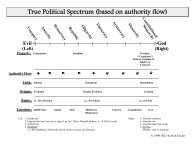
Do you remember this image Bob made a while back? (one of three, iirc)

political-spectrum-correct.jpg

The relevant point is the authority-flow row.

This is where I think you are flattening the hierarchy. The king being the supreme judge in the land does not mean he is merely one judge within a judicial department. He is not simply the highest employee in the judiciary. He is the head of the civil hierarchy.

Righteous authority flows downhill. Authority comes from God, through the lawful ruler, and then down through subordinate offices.

A lower judge can be tried by a higher judge because authority flows downward from the superior office to the subordinate office. But if the highest judges beneath the king can try, condemn, and remove the king, then authority is flowing uphill.

If subordinate judges can remove the supreme judge, authority is no longer flowing downhill.

So the issue is not whether the king may commit corruption. Of course he may. The issue is whether there is an earthly civil authority above him with jurisdiction to punish him.

You are saying he should be subject to the same penalties as any other judge. But he is not “any other judge.” He is the final earthly civil authority. If he is punished by the judiciary, then the judiciary is the final earthly civil authority, not the king.

At that point, it does not matter that we still call him king. The bench has the final word over the crown.

If there must be a hierarchy then the law itself should be at the top of the heap, not any man because the authority to have and enforce laws came from God.

Yes, and that is already what the proposed Constitution has.

The king is under the law. He is not free to invent justice, disregard the Criminal Code, or rule as though God’s law does not bind him.

But saying “the law is above the judiciary” does not answer the question. I can say the same thing about the king. The king is under the law too.

That is the very point: both systems have men under law. The dispute is not whether someone is under the law, but who has final earthly authority to apply it when the highest authority in that system goes rogue.

You object that a rogue king may violate the law and that there must be some legal procedure to restrain him. But when I point out that your proposed judicial mechanism could also become rogue, your answer is that there would be legal procedures to restrain rogue judges.

That just pushes the same question one level higher.

Who enforces those procedures?
- If the king enforces them, then the king controls the mechanism that is supposed to restrain him.
- If the judiciary enforces them, then the judiciary is the final earthly authority.
- If some third body enforces them, then that third body is the final earthly authority.

You have not escaped the problem. You have only moved it to whichever man, panel, court, or institution gets the final word.

Every civil system eventually reaches a point where no higher earthly court exists. The question is where that point should be.

Bob’s system places final earthly civil authority firmly in one visible, mortal, historically accountable king under God’s law.

Your proposal places it in an institutional judicial class under God’s law.

So the question is not whether anyone is “under the law.” Everyone is under the law. The question is where final earthly jurisdiction resides.

Why then should the man at the top of the legal system get to disregard that law if he so chooses to do so?

He should not.

But that question assumes the very thing in dispute.

Saying there is no higher earthly court over the king is not the same thing as saying the king “gets to disregard” the law. It means he is the final earthly civil authority, not that he is morally permitted to violate God’s law.

The same problem exists in your system, just one level removed. If the highest judicial body is the final earthly authority, why should those men get to disregard the law if they choose to do so?

You can answer, “They should not.” And I agree. But that does not tell us who has final earthly jurisdiction over them.

So your objection does not eliminate the problem. It just moves it from the king to the judiciary.

Every system has someone at the top who, in the earthly civil sense, has no higher court above him. That's how God designed man to function. (Think of how even Abraham acted as the head of his tribe when he went out to recover Lot.) That does not mean he has a right to do evil. It means his accountability is not administered by a superior civil office.

The king is under God’s law. He is accountable to God, to history, to his own conscience, to public resistance, and eventually to death and judgment. But if another civil body can legally punish and remove him, then that body is the final earthly authority, not the king.

And that has far-reaching consequences... Consequences I think are more far-reaching than your proposal accounts for.

At bottom, the difference between our positions is that one of us believes that the law places someone above itself.

My question is...

By what right?

There is actually very little difference between our positions when they are considered as complete systems. In both systems, the ruler is under the law. In both systems, the judges are under the law. In both systems, everyone is morally bound by God’s standard of justice.

Both positions have men under law. Both positions recognize that law is the standard. Both positions still require some earthly authority to apply that law.

The only real difference is who has the final earthly say.

In my position, the king has the final earthly say under the law.
In your position, the judiciary has the final earthly say under the law.

So this is not a question of whether the law places someone “above itself.” It does not. No one is above God’s law.

The question is where final earthly jurisdiction resides. You place it in the highest judges. I place it in the king.

Because that is how authority is structured.

And if you ask, “By what right?” my answer is: by the nature of final earthly civil authority. Every civil system has it somewhere. Yours does too. You have not removed it. You have only moved it from one visible man to a panel of men who may or may not be just as evil as the king they seek to remove.

There can be no answer! Any right you describe would be a description of a law because that's what the law is, a delineation of rights and the consequences for violating them.

This still does not answer the issue with your addition.

Yes, law delineates rights and penalties. No dispute there.

But law does not act on its own. Law does not arrest, indict, try, sentence, remove, or execute judgment. Men do those things.

So when you ask, “By what right?” the answer is not that the king has a right to violate the law. He does not. The answer is that every civil order must have a final earthly authority responsible for applying the law, and your proposal has one just as much as mine does.

In my position, that final earthly authority is the king.
In your position, that final earthly authority is the judiciary.

You are not avoiding the need for final authority by saying “the law.” You are simply placing final authority in the men who get to interpret and enforce the law against the king.

So again, the disagreement is not whether law defines rights or whether the king is morally bound by law. The disagreement is whether final earthly jurisdiction rests in the king or in the judges who can remove him.

My position, and Bob’s as far as I can tell, is that creating a legal mechanism by which evil judges can remove a righteous king is not a solution to tyranny. It is only another road to it.

And like I said above, that has far-reaching consequences, very far-reaching indeed.
 

Idolater

Popetard
King David was under the law, in the sense that he was an Israelite Jew, and he along with all other circumcised Israelite Jews was under the law of Moses. Except David committed not just adultery, but murder. But he wasn't arrested or removed from office. He was judged by no man, since he was an absolute monarch, which means in an important sense that King David and his office is not under the law.

Law cashes out in its execution and enforcement. Therefore if someone breaks a law, the execution and enforcement is carried out by a party. That party is the highest power in that political situation.

If you claim you have a king but he can be arrested if he breaks the law, it's the arresting party with the highest power, and you have a constitutional or limited, as opposed to absolute monarchy.

If there were a party who could arrest King David after he cucked and then murdered a man, they would have. Instead King David is chastised indirectly by the Lord God Himself, working through His prophet Nathan. So under Israel's political situation this is the only constitutional limitation to David's throne. The monarch is judged by no man but only by God, under this system.

obv today there's no prophets. That office is vacant. So how does God judge an otherwise absolute monarch today? What is the mechanism?


A completely false authority.

A completely false hierarchy.

Another false authority.

The RCC is false through and through.

If you were following the thread you would probably notice my post wasn't a promotion of Catholicism, just an example of a analogous situation that exists rn irl that is apropos to what @Clete and JR are DISCUSSING. The pope is judged by no man, only by God. The college of bishops, the princes of the Church, doesn't have the power to arrest, indict, penalize, punish, remove or depose the pope, no matter how bad he is. They have the power to remove a man who is not the pope, from the pope's home. Just like any intruder. The pope, as long as he doesn't quit, is judged by no man. iow the pope as long as he is the pope is an absolute monarch.
 

Idolater

Popetard
King David was under the law, in the sense that he was an Israelite Jew, and he along with all other circumcised Israelite Jews was under the law of Moses. Except David committed not just adultery, but murder. But he wasn't arrested or removed from office. He was judged by no man, since he was an absolute monarch, which means in an important sense that King David and his office is not under the law.

Here are some people RECENTLY who have not been under the law—they were ABOVE the law:
Hitler
Stalin
Lenin
Mao
Castro

Noticing any pattern? This is why we are so resistant to the idea of an absolute monarchy. Our American Founders' experience with the British crown ('the crown' is just another name for the office or throne of the monarch or king) pales in comparison to that of the victims of the autocrats listed above, and that was all RECENT.

Whatever you want to call the political situations put in place by these men, whether it was totalitarian, communist, tyrannical, autocratic or a dictatorship, re this thread, they cashed out in the fact that those men were all above the law, and were judged by no man. They could and did get away with murder, and any other capital crime they wanted. They made themselves untouchable.

If there were some way to give some party the power to hold custody of the supreme office in a country or polity, such that they would administer the succession and continuity when the office was vacant due to the death of its previous holder, or to his resignation, then the bottom line in physically real terms is that you'd have a constitutional limit to an absolute monarchy, it just wouldn't be direct limitation. The king could do whatever, and be judged by no man—except quit. If he quits, then ofc, he's no longer king. I mean obv the king can quit if he wants to. Nobody can stop him. He is judged by no man, even in his decision to quit or retire. No one can tell him, "No."

But if he says, "I quit," then there is a party empowered to swoop in, and say to the now former king, "Then get out." I mean respectfully, if appropriate, but if he is a manifest capital criminal, then not necessarily either.
 

Synergos

New member
So what happens in such a system when the king hates God and doesn't care about following the law?
Consider the following statements:

"10803. The king who regards the laws as above himself, and thus himself as beneath the laws, makes the royalty to consist in the law, and the law rules over him; for he knows that the law is justice, and all justice that is justice is Divine. But he who regards the laws as beneath him, and thus himself as above them, makes the royalty to consist in himself, and either believes himself to be the law, or the law which is justice to be from himself; consequently he arrogates to himself that which is Divine, and under which he must be.

10804. The law which is justice must be brought forward by persons in the realm learned in the law, who are wise and god-fearing; in accordance with which the king and his subjects must then live. The king who lives in accordance with the law which is justice, and therein sets an example to his subjects, is truly a king.

10805. A king who has absolute power, and who believes that his subjects are such slaves that he has a right to their lives and properties, and who exercises this power, is not a king, but a tyrant." (Swedenborg, Arcana Coelestia)

The challenge is when the kings in the christian world do not follow the Lord, promote those laws/principles which are essentially contrary to the foundations of the spiritual life, then at the very least, if the system of goverment is aligned with false principles, it is equally corrupted. As the history shows, such system do not survive for a long time.

So, unless there is a repentance, there may be a disintegration of the system, the various internal and external wars.
 

Right Divider

Body part
If you were following the thread you would probably notice my post wasn't a promotion of Catholicism, just an example of a analogous situation that exists rn irl that is apropos to what @Clete and JR are DISCUSSING. The pope is judged by no man, only by God.
You are completely delusional... you promote RCCism all the time... like you did right there... AGAIN.
The college of bishops, the princes of the Church, doesn't have the power to arrest, indict, penalize, punish, remove or depose the pope, no matter how bad he is.
They are ALL a FALSE authority.
They have the power to remove a man who is not the pope, from the pope's home.
Who cares what the FALSE authority has the "power" to do?
Just like any intruder. The pope, as long as he doesn't quit, is judged by no man. iow the pope as long as he is the pope is an absolute monarch.
The "pope" is a pretend monarch over of pretend kingdom.
 

Idolater

Popetard
But if [the sitting monarch] says, "I quit," then there is a party empowered to swoop in, and say to the now former king, "Then get out." I mean respectfully, if appropriate, but if he is a manifest capital criminal, then not necessarily either.

In Catholicism there is a common motive to continue the Church. On paper the college of bishops could conspire to usurp the papacy but then you no longer have the same Church. Under such conditions you'd have to think that while the true papacy exists metaphysically, it is vacant because the party which holds custody of the office is composed of usurpers.

If you believe this, then you work toward the day in the future where the bishops aren't usurpers, so that a real pope will once again hold the office, and sit on Peter's throne (which is David's throne's vicariate, the office depicted in Isaiah 22:22).

What kind of analogous situation would we need in the secular, civil sphere to help envision the idea of a party who holds custody of a crown, but is not the monarchy itself? It would be impossible to regulate since they are in charge of succession. Which is why it's important that there is a common motive between the people, the party who holds custody of the crown, and the monarch himself, to keep the whole thing together for generations on end, in perpetuity or until Kingdom Come. With such a common motive, it can also be easily deduced if or when a king resigns.

Can a manifest capital criminal be said to have de facto quit as king? Is this a common motive? It would seem to me that if it were, then Germany and Russia and China could have removed their dictators, because they had obv quit the job. But no such procedure prevailed in those political situations. The people thought that this activity was consistent with a monarch that they must have thought they all deserved.

Whatever this hypothetical common motive might be, it would be in a sense above even the supreme law of the land, because it would inform the supreme law of the land, the supreme law of the land would comport with this common motive, without being that motive. There must be motivation in each party that continues a monarchy, it must be a motivated activity and not unbiased and neutral, it's something everybody wants. This is why Catholicism can work, there is an overarching motive, it's God Who is that common motive.

In the civil sphere, how do you ensure that the people, the monarchy, and the party who holds direct custody of the monarchy are all aligned in motivation?
 

Clete

Truth Smacker
Silver Subscriber
But this simply relocates the problem.

You say the judiciary would be under the law.
So is the king.

You say the judiciary would have no power to make new law.
Fine. But that does not prevent the judiciary from using the threat of removal to influence the king’s rule. If the king knows that the highest judges can indict, try, remove, and replace him, then the judiciary does not need formal legislative power. It can control him by holding the removal process over his head.

At that point, the king may still wear the crown, but he rules under judicial supervision. That makes him less a monarch than a puppet of the men who can remove him.

And when you say there would be procedures to deal with rogue judges, the same problem returns: enforced by whom?

If those procedures are enforced by the king, then the king need only use that authority against any “rogue” judge who threatens his rule. A wicked king would simply define his righteous opposition as judicial corruption and purge the men most likely to bring charges against him. Which is exactly the point you made to me a while back when I brought up civil disobedience as a deterrent against an evil king, remember?

But if those procedures are not enforced by the king, then they are enforced by some authority independent of him. And that authority, not the king, is the final earthly authority. Over time, that is how you get an unelected evil institutional ruling class that can control the throne without openly wearing the crown.

So we are right back to the same dilemma I pointed out earlier:

"A removal mechanism controlled by the king cannot restrain him, and a removal mechanism not controlled by the king outranks him."

You have not solved the problem of an evil ruler. You have only moved the problem from the king to whichever men control the mechanism that judges the king.


Do you remember this image Bob made a while back? (one of three, iirc)

View attachment 15776

The relevant point is the authority-flow row.

This is where I think you are flattening the hierarchy. The king being the supreme judge in the land does not mean he is merely one judge within a judicial department. He is not simply the highest employee in the judiciary. He is the head of the civil hierarchy.

Righteous authority flows downhill. Authority comes from God, through the lawful ruler, and then down through subordinate offices.

A lower judge can be tried by a higher judge because authority flows downward from the superior office to the subordinate office. But if the highest judges beneath the king can try, condemn, and remove the king, then authority is flowing uphill.

If subordinate judges can remove the supreme judge, authority is no longer flowing downhill.

So the issue is not whether the king may commit corruption. Of course he may. The issue is whether there is an earthly civil authority above him with jurisdiction to punish him.

You are saying he should be subject to the same penalties as any other judge. But he is not “any other judge.” He is the final earthly civil authority. If he is punished by the judiciary, then the judiciary is the final earthly civil authority, not the king.

At that point, it does not matter that we still call him king. The bench has the final word over the crown.


Yes, and that is already what the proposed Constitution has.

The king is under the law. He is not free to invent justice, disregard the Criminal Code, or rule as though God’s law does not bind him.

But saying “the law is above the judiciary” does not answer the question. I can say the same thing about the king. The king is under the law too.

That is the very point: both systems have men under law. The dispute is not whether someone is under the law, but who has final earthly authority to apply it when the highest authority in that system goes rogue.

You object that a rogue king may violate the law and that there must be some legal procedure to restrain him. But when I point out that your proposed judicial mechanism could also become rogue, your answer is that there would be legal procedures to restrain rogue judges.

That just pushes the same question one level higher.

Who enforces those procedures?
- If the king enforces them, then the king controls the mechanism that is supposed to restrain him.
- If the judiciary enforces them, then the judiciary is the final earthly authority.
- If some third body enforces them, then that third body is the final earthly authority.

You have not escaped the problem. You have only moved it to whichever man, panel, court, or institution gets the final word.

Every civil system eventually reaches a point where no higher earthly court exists. The question is where that point should be.

Bob’s system places final earthly civil authority firmly in one visible, mortal, historically accountable king under God’s law.

Your proposal places it in an institutional judicial class under God’s law.

So the question is not whether anyone is “under the law.” Everyone is under the law. The question is where final earthly jurisdiction resides.


He should not.

But that question assumes the very thing in dispute.

Saying there is no higher earthly court over the king is not the same thing as saying the king “gets to disregard” the law. It means he is the final earthly civil authority, not that he is morally permitted to violate God’s law.

The same problem exists in your system, just one level removed. If the highest judicial body is the final earthly authority, why should those men get to disregard the law if they choose to do so?

You can answer, “They should not.” And I agree. But that does not tell us who has final earthly jurisdiction over them.

So your objection does not eliminate the problem. It just moves it from the king to the judiciary.

Every system has someone at the top who, in the earthly civil sense, has no higher court above him. That's how God designed man to function. (Think of how even Abraham acted as the head of his tribe when he went out to recover Lot.) That does not mean he has a right to do evil. It means his accountability is not administered by a superior civil office.

The king is under God’s law. He is accountable to God, to history, to his own conscience, to public resistance, and eventually to death and judgment. But if another civil body can legally punish and remove him, then that body is the final earthly authority, not the king.

And that has far-reaching consequences... Consequences I think are more far-reaching than your proposal accounts for.


There is actually very little difference between our positions when they are considered as complete systems. In both systems, the ruler is under the law. In both systems, the judges are under the law. In both systems, everyone is morally bound by God’s standard of justice.

Both positions have men under law. Both positions recognize that law is the standard. Both positions still require some earthly authority to apply that law.

The only real difference is who has the final earthly say.

In my position, the king has the final earthly say under the law.
In your position, the judiciary has the final earthly say under the law.

So this is not a question of whether the law places someone “above itself.” It does not. No one is above God’s law.

The question is where final earthly jurisdiction resides. You place it in the highest judges. I place it in the king.

Because that is how authority is structured.

And if you ask, “By what right?” my answer is: by the nature of final earthly civil authority. Every civil system has it somewhere. Yours does too. You have not removed it. You have only moved it from one visible man to a panel of men who may or may not be just as evil as the king they seek to remove.


This still does not answer the issue with your addition.

Yes, law delineates rights and penalties. No dispute there.

But law does not act on its own. Law does not arrest, indict, try, sentence, remove, or execute judgment. Men do those things.

So when you ask, “By what right?” the answer is not that the king has a right to violate the law. He does not. The answer is that every civil order must have a final earthly authority responsible for applying the law, and your proposal has one just as much as mine does.

In my position, that final earthly authority is the king.
In your position, that final earthly authority is the judiciary.

You are not avoiding the need for final authority by saying “the law.” You are simply placing final authority in the men who get to interpret and enforce the law against the king.

So again, the disagreement is not whether law defines rights or whether the king is morally bound by law. The disagreement is whether final earthly jurisdiction rests in the king or in the judges who can remove him.

My position, and Bob’s as far as I can tell, is that creating a legal mechanism by which evil judges can remove a righteous king is not a solution to tyranny. It is only another road to it.

And like I said above, that has far-reaching consequences, very far-reaching indeed.
How is making it so that an evil king has legal carte blanche to do whatever he wants not an even shorter road to tyranny?

The judiciary would not be able to remove the king by fiat or whim over a long weekend. The process for removing the king would be legally complex thing to do that would require much more than some particular person deciding that he wanted to make a power move on the king. Also, the result would simply be another king, not the judiciary being installed as some sort of governing committee. A rather simple conflict of interest clause in the statute is all it would take to prevent a rogue judiciary from taking over. Simply make it part of the removal process that no member of the judiciary can be elevated to king as a result of a king being legally removed from his throne.

The king, on the other hand, could go totally rogue and do whatever he desired without consequence or recourse, precisely because, despite what you say, he absolutely does have the legal right to violate the law. He may not have a moral right to do so but he surely would have a legal right to do so because he cannot be prosecuted for any reason whatsoever. For such a king, all things would be lawful, whether they were beneficial or not, precisely because he has been installed above the law (so far as the law itself is concerned).

And I reject the notion that having a legal means by which a rogue king can be removed without the need for civil war, means that the judiciary is now somehow the highest authority such that all I've done is shifted the problem over to someone new. That just is not the case. First, as I just explained, the judiciary could not arbitrarily do anything to the king. Second, as I also explained, there'd be no incentive to remove a good king because they'd not be allowed to profit from his removal. In addition to that, the authority to remove is the only authority the judiciary would have over the king. They cannot use this authority to do anything other than to initiate proceedings to have the king legally removed for cause. Cause that they'd have to prove in court. There's no way for them to turn this authority into an ability to govern the nation. They cannot do any of the things a king does as the sovereign of a nation and so they'd have no means to become tyrannical. The only thing that would happen if one king is removed is that another king is selected. The means by which the replacement is selected would be delineated far in advance by the same law that gives the judiciary the authority to have removed the one being replaced.
 

Idolater

Popetard
... you promote RCCism all the time... like you did right there... AGAIN.

I did not.
Why don't you just put me on ignore like @Clete you're driving yourself mad.

They are ALL a FALSE authority.

Who cares what the FALSE authority has the "power" to do?

The "pope" is a pretend monarch over of pretend kingdom.

100 percent just missing the point. You're not following the thread. You came in suddenly, and all you did was take a potshot at me. Completely off topic btw, which I know you think is VERY WRONG.

Just put me on ignore. We'll all live a lot longer.
 

Right Divider

Body part
In Catholicism there is a common motive to continue the Church. On paper the college of bishops could conspire to usurp the papacy but then you no longer have the same Church. Under such conditions you'd have to think that while the true papacy exists metaphysically, it is vacant because the party which holds custody of the office is composed of usurpers.
LOL, you're a HOOT!
 

Right Divider

Body part
You're a retarded baby. No I didn't.
Your blindness is normal for you and any follower of the false RCC.

In almost every post you claim that "The pope is judged by no man".... That is a FALSE authority. Myself and every true believer in Christ judges the "pope" as an anti-Christ.
You're not following the discussion. Just put me on ignore.
I don't take orders from you, thanks.

P.S. You have the "ignore" feature as well.
 

Idolater

Popetard
Your blindness is normal for you and any follower of the false RCC.

In almost every post you claim that "The pope is judged by no man".... That is a FALSE authority. Myself and every true believer in Christ judges the "pope" as an anti-Christ.

You're not following the discussion. Catholicism and the papal office is an ANALOGY. Leave the thread, or bone up on it so you can contribute constructively to it.

I don't take orders from you, thanks.

P.S. You have the "ignore" feature as well.

[Redacted.]
 

JudgeRightly

裁判官が正しく判断する
Staff member
Administrator
Super Moderator
Gold Subscriber
How is making it so that an evil king has legal carte blanche to do whatever he wants not an even shorter road to tyranny?

You are still treating tyranny of an evil king as the only danger. I'm saying there are greater dangers than that.

Yes, the king may become a tyrant. Yes, the fact that the king cannot be lawfully removed by another earthly office may result in tyranny. I am not denying that danger. It's even acknowledged as part of the system.

The problem is that your proposed alternative does not avoid tyranny. It opens the door to something beyond the tyranny of one man.

"The cure is worse than the disease," as Bob used to say.

The disease is an evil king, and that is bad enough. But the cure you are proposing creates a standing mechanism by which the one can be overthrown by the few, even if the few are not themselves part of the removal mechanism.

A wicked king is visible. He is personal. He is mortal. His reign can be named, remembered, condemned, resisted, and judged by history. And, at the very least, he will eventually die.

But a corrupted removal mechanism is different. It can become institutional. It can outlive the men who first created it. It can learn, adapt, recruit, build precedent, hide behind procedure, and pass its corruption from one generation to the next. Worse, it can make rebellion look lawful.

That does not halt the danger Polybius described. It resumes it. The one is replaced by the few, the few eventually become an oligarchy, and the cycle starts turning again.

If the king has no meaningful influence over the removal mechanism, then he becomes subject to the men who control that mechanism. At that point, the king, evil or not, rules only so long as they permit him to rule. That makes him a puppet.

But if the king does have meaningful influence over the removal mechanism, then the mechanism is powerless against him. A wicked king will simply shape it, control it, intimidate it, or use it against the very men who threaten his rule, from the very moment he learns of its existence.

There is no stable middle ground here. Either the king eventually becomes a puppet of the system created to remove him, or the system becomes a tool of the tyrant king.

That is why I keep saying the danger is not merely “an evil king.” The danger is what happens when the proposed cure creates the next stage of decay. A removal mechanism does not merely answer tyranny; it risks advancing the process Polybius described. The one is replaced by the few, again, even if they aren't formally part of the process and the few eventually become an oligarchy, even if there remains a king on the throne.

So Bob’s Constitution does not pretend an evil king is impossible. Rather, it refuses to build the next stage of anacyclosis into the system. If the king becomes evil, that is a grievous thing. But at least he remains one visible, mortal, historically accountable man. He will die.

The judiciary would not be able to remove the king by fiat or whim over a long weekend. The process for removing the king would be legally complex thing to do that would require much more than some particular person deciding that he wanted to make a power move on the king.

But that is not a point in its favor.

The fact that the process would be legally complex is all the more reason to avoid it. Justice, when brought, should be swift and painful. Complexity adds time, and time gives evil room to organize, manipulate, threaten, flatter, bribe, redefine terms, build coalitions, and wait out opposition.

The forces of evil are very patient. And I do not mean only evil men. Spiritual forces do not have to worry about dying, aging out, losing interest, or failing to see the long game through. Men die. Institutions can outlive men. And the spiritual powers that exploit those institutions are more patient still.

A complicated judicial removal process would not merely be a safeguard against rash action. It would also become a target for patient men who know how to use institutions. The judiciary is just as subject to corruption and influence as the king is, and perhaps even more useful to evil if it can be used as a lawful-looking tool to remove a righteous king from power.

Have you ever heard of the long march through the institutions?

That is the danger here. Evil does not need to seize the throne in one dramatic act if it can slowly capture the mechanism that controls the throne. It can work through credentials, appointments, promotions, professional respectability, procedural precedent, and institutional culture.

And this is not hard to imagine. Our current government already shows how much power can be exercised by people and interests that do not openly hold the highest office. They influence the bureaucracy, the courts, the agencies, the money, the media, and the institutions that shape what government actually does and even how the people perceive it.

So why assume the same kind of forces would not eventually form around a king-removal mechanism?

If such a mechanism exists, then every ambitious faction knows exactly where to aim: not necessarily at the crown, but at the process that can remove the crown. Capture that, and you can remove a good king while claiming to defend the law.

So, no, the fact that it would not happen “over a long weekend” does not comfort me. The more complex the process, the more institutional it becomes. And the more institutional it becomes, the easier it is for patient evil men to capture over time.

Also, the result would simply be another king, not the judiciary being installed as some sort of governing committee.

This is technically true, but it misses the point.

The danger is not only that the judiciary might install itself as a governing committee. The danger is that a removal mechanism gives evil men a lawful-looking way to remove an unusually righteous king.

Evil hates the good. It hates the righteous. It hates the upright. So imagine a genuinely good king, one who resists corruption, refuses flattery, cannot be bribed, will not bend to institutional pressure, and will not permit evil men to use his government for their own ends.

What would evil do?

It would not necessarily need to install one of its own men directly. It would only need to remove the man standing in its way.

Yes, under the proposed succession process, especially if a lottery is involved, the conspirators may not be able to directly choose the next king. But that does not mean the removal is harmless. The odds are very good that the next king will not be as principled, as resistant, as wise, or as difficult to manipulate as the one they removed.

So the replacement does not have to be their hand-picked puppet in order for the removal to serve evil. Evil can profit simply by taking down a righteous king and rolling the dice on someone weaker.

That is one of the forms of decay this constitution is trying to prevent, or at least slow down as much as possible.

A removal mechanism does not merely threaten evil kings. Over time, it also threatens the very kings most likely to resist the institutional forces trying to corrupt the nation.

A rather simple conflict of interest clause in the statute is all it would take to prevent a rogue judiciary from taking over. Simply make it part of the removal process that no member of the judiciary can be elevated to king as a result of a king being legally removed from his throne.

That only answers a very narrow version of the objection.

I am not arguing that the judiciary will formally take over the government or that one of the judges will remove the king and then personally become king. That would be the most obvious and least subtle abuse.

The deeper problem is that whoever controls, captures, influences, or intimidates the judiciary will use whatever tools are available to gain power and destroy what is good.

That could be men within the judiciary. It could be powerful interests outside the judiciary. It could be a faction operating from the shadows. It could be, ultimately, Satan himself working through whatever instruments are available.

The point is not that the judges must personally wear the crown. The point is that the removal mechanism becomes a weapon. Once that weapon exists, evil has an obvious target: capture the men who control it, and then use it against any king who stands in the way.

A conflict-of-interest clause might prevent a judge from becoming king after a removal. Fine. But it does not prevent the judiciary from being used to remove a righteous king, destabilize the throne, intimidate future kings, create precedent, or clear the way for someone weaker, more corruptible, or less resistant to evil.

Evil does not need a judge to wear the crown. It only needs the judge to remove the man who refuses to bow.

So the danger is not simply “the judiciary takes over.” The danger is that the judiciary becomes the lever by which others take over.

The king, on the other hand, could go totally rogue and do whatever he desired without consequence or recourse, precisely because, despite what you say, he absolutely does have the legal right to violate the law. He may not have a moral right to do so but he surely would have a legal right to do so because he cannot be prosecuted for any reason whatsoever. For such a king, all things would be lawful, whether they were beneficial or not, precisely because he has been installed above the law (so far as the law itself is concerned).

No, he would not have the legal right to violate the law.

You are confusing the absence of a superior earthly prosecutor with legal permission.

Just because the king can do something does not mean he has the right to do it. And just because no higher earthly office can prosecute him does not mean he is not accountable at all.

My position is not that the king is “installed above the law,” regardless of how you frame it. He is under the law. He is bound by the Constitution and Criminal Code. If he violates them, he acts unlawfully.

The issue is not whether his conduct is lawful. It is not.

The issue is whether there is a superior earthly civil office with jurisdiction to prosecute him.

Those are different questions.

A man may be guilty before God and before the law even when no earthly court has authority to punish him. That does not make his evil lawful. It means his accountability is not administered by a superior domestic tribunal.

So no, “all things” would not be lawful for the king. If he breaks the law, he breaks the law. The question is not whether he is above the law. The question is whether creating a higher earthly court over him destroys the monarchy by making that court the final earthly authority.

And I reject the notion that having a legal means by which a rogue king can be removed without the need for civil war, means that the judiciary is now somehow the highest authority such that all I've done is shifted the problem over to someone new. That just is not the case.

It is the case, whether you accept the description or not, because that is how authority works.

If the judiciary can indict, try, condemn, remove, and replace the king, then in that matter the judiciary is above the king. It does not matter that the authority is limited to removal. It does not matter that it is legally defined. It does not matter that it is only used in extraordinary circumstances.

At the decisive point, the judiciary has authority over the throne.

That means final earthly jurisdiction has shifted from the king to the body that can decide whether he remains king.

Authority flows downhill. If the judges beneath the king can remove the king, then authority is flowing uphill. Calling that “legal means” does not change the direction of authority.

And I am not saying this necessarily makes the judiciary the day-to-day governing committee. That is not the point. The point is that it makes the judiciary the final earthly authority over the office of king.

Whoever has final authority over the throne is above the throne.

First, as I just explained, the judiciary could not arbitrarily do anything to the king.

But “not arbitrary” is not the same thing as “not corrupt.”

The danger is not merely that the judiciary might wake up one morning and remove the king on a whim. The danger is that a captured or corrupt judiciary could remove a righteous king through a lawful-looking process, using the very procedures designed to restrain abuse.

Plenty of evil is done non-arbitrarily. It is done carefully, procedurally, with paperwork, precedent, witnesses, hearings, findings, and official language.

That is exactly what makes institutional corruption so dangerous. It does not have to look like a coup. It can look like due process.

So the question is not whether your proposed process would be arbitrary. The question is whether it can be captured, corrupted, or weaponized over time. And if it can, then the fact that it is procedural does not comfort me.

Second, as I also explained, there'd be no incentive to remove a good king because they'd not be allowed to profit from his removal.

That's naïve, Clete.

The fact that he is a good king is incentive enough for evil to remove him.

That IS the profit.

A righteous king restrains wicked men. He blocks corrupt schemes. He refuses bribes. He resists flattery. He punishes crime. He exposes what others want hidden. He prevents institutions from being used for evil ends.

So if evil men, corrupt interests, or spiritual forces cannot control him, they have every incentive to remove him.

They do not need to personally become king in order to profit. They profit by removing the obstacle.

And even if the next king is chosen by lottery, that does not eliminate the incentive. The next king does not have to be hand-picked by them. He only has to be weaker, less wise, less principled, less experienced, more fearful, more corruptible, or more susceptible to influence than the good king they removed.

So yes, there is incentive to remove a good king.

The incentive is that he is good.

In addition to that, the authority to remove is the only authority the judiciary would have over the king. They cannot use this authority to do anything other than to initiate proceedings to have the king legally removed for cause. Cause that they'd have to prove in court.

But that “only authority” is exactly the authority evil would need to capture.

If the judiciary has power to initiate proceedings against the king and remove him for cause, then the obvious target for anyone seeking power is the institution that defines, evaluates, and proves “cause.”

A captured judiciary does not need broad governing power. It only needs control over the one process that can remove the king.

And once the institution is captured, the requirement to “prove cause” is not the safeguard you think it is. The captured court only needs enough evidence, or apparent evidence, to justify what it already wants to do.

False witnesses exist. Manufactured evidence exists. Selective presentation of facts exists. Procedural abuse exists. Public pressure exists. And if the institution is already corrupt, it is not going to look very hard for reasons to acquit the king it wants removed.

That is the danger.

The process does not have to be arbitrary. It does not have to be openly lawless. It only has to be captured. Once captured, it can remove a righteous king while claiming to have proved cause in court.

There's no way for them to turn this authority into an ability to govern the nation. They cannot do any of the things a king does as the sovereign of a nation and so they'd have no means to become tyrannical.

Again, I think this underestimates how power works.

They do not need to formally govern the nation in order to control the direction of the nation.

If the judiciary can remove the king, then every king knows he rules under the shadow of that power. The judiciary does not have to command the military, levy taxes, manage infrastructure, or issue daily orders in order to influence what the king does. It only has to make clear what kind of king will be tolerated.

That is more than enough.

Power does not always operate by openly taking the throne. Sometimes it operates by controlling the conditions under which the man on the throne is allowed to remain there.

A captured judiciary could pressure a king, intimidate him, chill his willingness to act, punish him for resisting institutional agendas, or remove him if he refuses to bend. Then the next king learns the lesson.

That is rule by threat, not rule by title.

So no, the judiciary may not become tyrannical in the same way a king can. It would not look like one man issuing royal decrees. It would look like an institutional class shaping the behavior of every king through the standing threat of removal.

That is still tyranny. It is just less visible.

The only thing that would happen if one king is removed is that another king is selected. The means by which the replacement is selected would be delineated far in advance by the same law that gives the judiciary the authority to have removed the one being replaced.

But as I already addressed above, sometimes simply removing a good king is all evil needs.

The replacement does not have to be hand-picked by the conspirators in order for the removal to serve their ends. If the current king is unusually righteous, unusually resistant to corruption, and unusually difficult to manipulate, then removing him is already a victory for evil.

Another king may be selected, yes. But “another king” is not necessarily an equal replacement. He may be weaker, less wise, less principled, less experienced, more fearful, more corruptible, or more susceptible to pressure.

So the fact that the succession process is written in advance does not solve the problem. The danger is not only who gets installed next. The danger is that the removal mechanism gives evil a lawful-looking means to remove the very sort of king most likely to slow the nation’s decay.

The issue is not whether a replacement process exists on paper. The issue is what kind of power the removal mechanism creates in practice. If evil can use that mechanism to remove the very king resisting it, then the cure has become another path to the same national decay we're trying to avoid.

 
Top