

You are using an out of date browser. It may not display this or other websites correctly.
You should upgrade or use an alternative browser.
You should upgrade or use an alternative browser.
Mid-Acts Presentations
- Thread starter Right Divider
- Start date
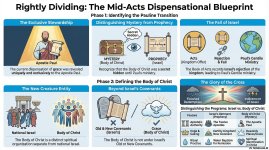

In reference to the bottom right square in that presentation, and specifically in regard to the issue of water baptism, it seems to me that if a person approaches Paul’s epistles without importing a large theological framework beforehand, it is very difficult to conclude that water baptism is forbidden for members of the Body of Christ, as many Mid-Acts believers teach.
That does not mean that baptism is required. It certainly is not part of the gospel of grace, and Paul himself goes out of his way to distinguish the two. In I Corinthians 1:17 he says plainly, “Christ did not send me to baptize, but to preach the gospel.” That statement alone is enough to remove baptism from the category of saving ordinances. Salvation is through faith in Christ alone.
At the same time, that passage does not condemn the practice. In the very same context Paul acknowledges that he personally baptized Crispus, Gaius, and the household of Stephanas. His concern in that chapter is not that baptizing them was wrong, but that the Corinthians were dividing themselves into factions based on who baptized whom. In other words, Paul corrects their misuse of the practice without ever suggesting that the practice itself was sinful or illegitimate.
That observation matters because Paul is not shy about correcting things that should not be happening in the churches. When the Corinthians abused spiritual gifts, he corrected them. When they tolerated sexual immorality, he corrected them. When they distorted the Lord’s Supper, he corrected them. Yet nowhere in his epistles do we find an instruction telling believers to stop baptizing people.
Paul also speaks of baptism positively in several places. Romans 6 uses baptism imagery to describe union with Christ in His death and resurrection. Colossians 2 does the same thing. Whether one ultimately understands those passages to refer to Spirit baptism or not, the point remains that Paul employs the language constructively, not polemically.
For that reason it should not surprise us that many sincere believers read Paul and conclude that water baptism may still be practiced as a symbolic expression of faith, even if it is not required for salvation and not central to the gospel message.
From a Mid-Acts perspective we rightly insist that the gospel of the grace of God is faith in Christ apart from works, ordinances, or rituals. On that point there should be no compromise. Baptism does not save, does not cleanse sin, and does not add anything to the finished work of Christ.
However, recognizing that baptism is unnecessary for salvation does not automatically require the conclusion that the practice itself is forbidden.
A Mid-Acts believer could reasonably say something like this:
Paul clearly separates baptism from the gospel.
Paul personally baptized some believers.
Paul never commands believers to stop baptizing.
Paul occasionally uses baptism language positively in his teaching.
Given those facts, one could defensibly conclude that practicing water baptism as a voluntary symbol of identification with Christ is permissible, even if it is not required and carries no saving significance.
In other words, insisting that baptism is necessary would contradict Paul, but insisting that baptism is forbidden goes beyond what Paul actually says.
For those reasons, it seems to me that a Mid-Acts believer could reasonably hold that water baptism is unnecessary, non-saving, and secondary, yet still allowable as a symbolic act for those who wish to practice it.
That does not mean that baptism is required. It certainly is not part of the gospel of grace, and Paul himself goes out of his way to distinguish the two. In I Corinthians 1:17 he says plainly, “Christ did not send me to baptize, but to preach the gospel.” That statement alone is enough to remove baptism from the category of saving ordinances. Salvation is through faith in Christ alone.
At the same time, that passage does not condemn the practice. In the very same context Paul acknowledges that he personally baptized Crispus, Gaius, and the household of Stephanas. His concern in that chapter is not that baptizing them was wrong, but that the Corinthians were dividing themselves into factions based on who baptized whom. In other words, Paul corrects their misuse of the practice without ever suggesting that the practice itself was sinful or illegitimate.
That observation matters because Paul is not shy about correcting things that should not be happening in the churches. When the Corinthians abused spiritual gifts, he corrected them. When they tolerated sexual immorality, he corrected them. When they distorted the Lord’s Supper, he corrected them. Yet nowhere in his epistles do we find an instruction telling believers to stop baptizing people.
Paul also speaks of baptism positively in several places. Romans 6 uses baptism imagery to describe union with Christ in His death and resurrection. Colossians 2 does the same thing. Whether one ultimately understands those passages to refer to Spirit baptism or not, the point remains that Paul employs the language constructively, not polemically.
For that reason it should not surprise us that many sincere believers read Paul and conclude that water baptism may still be practiced as a symbolic expression of faith, even if it is not required for salvation and not central to the gospel message.
From a Mid-Acts perspective we rightly insist that the gospel of the grace of God is faith in Christ apart from works, ordinances, or rituals. On that point there should be no compromise. Baptism does not save, does not cleanse sin, and does not add anything to the finished work of Christ.
However, recognizing that baptism is unnecessary for salvation does not automatically require the conclusion that the practice itself is forbidden.
A Mid-Acts believer could reasonably say something like this:
Paul clearly separates baptism from the gospel.
Paul personally baptized some believers.
Paul never commands believers to stop baptizing.
Paul occasionally uses baptism language positively in his teaching.
Given those facts, one could defensibly conclude that practicing water baptism as a voluntary symbol of identification with Christ is permissible, even if it is not required and carries no saving significance.
In other words, insisting that baptism is necessary would contradict Paul, but insisting that baptism is forbidden goes beyond what Paul actually says.
For those reasons, it seems to me that a Mid-Acts believer could reasonably hold that water baptism is unnecessary, non-saving, and secondary, yet still allowable as a symbolic act for those who wish to practice it.
Right Divider
Body part
While the argument for "permissibility" seeks a middle ground, a consistent Mid-Acts Pauline perspective suggests that continuing water baptism—even as a symbol—undermines the very revelation it intends to honor.In reference to the bottom right square in that presentation, and specifically in regard to the issue of water baptism, it seems to me that if a person approaches Paul’s epistles without importing a large theological framework beforehand, it is very difficult to conclude that water baptism is forbidden for members of the Body of Christ, as many Mid-Acts believers teach.
That does not mean that baptism is required. It certainly is not part of the gospel of grace, and Paul himself goes out of his way to distinguish the two. In I Corinthians 1:17 he says plainly, “Christ did not send me to baptize, but to preach the gospel.” That statement alone is enough to remove baptism from the category of saving ordinances. Salvation is through faith in Christ alone.
At the same time, that passage does not condemn the practice. In the very same context Paul acknowledges that he personally baptized Crispus, Gaius, and the household of Stephanas. His concern in that chapter is not that baptizing them was wrong, but that the Corinthians were dividing themselves into factions based on who baptized whom. In other words, Paul corrects their misuse of the practice without ever suggesting that the practice itself was sinful or illegitimate.
That observation matters because Paul is not shy about correcting things that should not be happening in the churches. When the Corinthians abused spiritual gifts, he corrected them. When they tolerated sexual immorality, he corrected them. When they distorted the Lord’s Supper, he corrected them. Yet nowhere in his epistles do we find an instruction telling believers to stop baptizing people.
Paul also speaks of baptism positively in several places. Romans 6 uses baptism imagery to describe union with Christ in His death and resurrection. Colossians 2 does the same thing. Whether one ultimately understands those passages to refer to Spirit baptism or not, the point remains that Paul employs the language constructively, not polemically.
For that reason it should not surprise us that many sincere believers read Paul and conclude that water baptism may still be practiced as a symbolic expression of faith, even if it is not required for salvation and not central to the gospel message.
From a Mid-Acts perspective we rightly insist that the gospel of the grace of God is faith in Christ apart from works, ordinances, or rituals. On that point there should be no compromise. Baptism does not save, does not cleanse sin, and does not add anything to the finished work of Christ.
However, recognizing that baptism is unnecessary for salvation does not automatically require the conclusion that the practice itself is forbidden.
A Mid-Acts believer could reasonably say something like this:
Paul clearly separates baptism from the gospel.
Paul personally baptized some believers.
Paul never commands believers to stop baptizing.
Paul occasionally uses baptism language positively in his teaching.
Given those facts, one could defensibly conclude that practicing water baptism as a voluntary symbol of identification with Christ is permissible, even if it is not required and carries no saving significance.
In other words, insisting that baptism is necessary would contradict Paul, but insisting that baptism is forbidden goes beyond what Paul actually says.
For those reasons, it seems to me that a Mid-Acts believer could reasonably hold that water baptism is unnecessary, non-saving, and secondary, yet still allowable as a symbolic act for those who wish to practice it.
The "One Baptism" Constraint
The most significant hurdle for the "permissible" view is Ephesians 4:5, which states there is "one baptism". If a believer maintains that they have been spiritually baptized into the Body of Christ (the substance) but also chooses to undergo water baptism (the symbol), they are functionally practicing two baptisms.In the Dispensation of Grace, the focus shifts from the "shadows" of the law to the "substance" of Christ. To maintain a symbolic ritual is to keep one foot in the prophetic program of Israel, where water was a requirement for ritual cleanliness and national priesthood.
1 Corinthians 1:17 is a Positive Exclusion
The text argues that Paul’s statement, "Christ sent me not to baptize," is not a condemnation. However, from a Mid-Acts view, this is seen as a positive command defining the scope of the new dispensation.- Paul isn't just saying baptism is "secondary"; he is saying it is not part of his commission.
- He expresses relief and thanks God that he did not baptize more people. If the practice were a helpful, permissible symbol of identification, it would be strange for an Apostle to be "thankful" he didn't facilitate it more often.
Optimization for Clarity
The argument suggests that if baptism isn't "forbidden," it should be "allowable." However, the goal of the Mid-Acts ministry is optimizing for the clarity of the Gospel.- Water baptism, by its very nature, suggests a human work or a ritual requirement.
- In a world where millions believe water is necessary for salvation, practicing it "symbolically" creates a ministerial problem and causes unnecessary confusion.
- If the Cross is the power, and the Spirit baptism is the reality, adding water is a "distraction" that risks making the Cross of Christ of "none effect" by shifting the focus back to a physical act.
Romans 6 and Colossians 2: Substance over Symbol
The provided text suggests Paul uses baptismal language "constructively." A stricter Mid-Acts reading argues that Paul is redefining the term entirely.- In Romans 6, the "baptism" produces a literal death to sin and a new life. Water cannot do this; only the Spirit can.
- By using the word "baptism" to describe a spiritual operation, Paul is showing the believer that they have the real thing, rendering the water (the ritual) obsolete.
Conclusion: While water baptism may not be a "sin," it is doctrinally inconsistent with the unique revelation given to Paul. To practice it is to obscure the "one baptism" of the Spirit and to cling to a transitional ritual that Paul himself eventually moved past.
I've heard all of those arguments many time before and they are compelling to a degree but not fully persuasive. At the end of the day, Paul himself was baptized in water as virtually the first act of his own faith and then proceeded to personally water baptize several people. And even if he later dropped the practice, he never explicitly forbids it. It would seem then that the thrust of the above argument would mean that Paul undermined his own ministry by not only practicing the ritual and recording himself as having done so but then never clearly explaining that he had done so in error and that the practice should be ended. Talk about causing unnecessary confusion.While the argument for "permissibility" seeks a middle ground, a consistent Mid-Acts Pauline perspective suggests that continuing water baptism—even as a symbol—undermines the very revelation it intends to honor.
The "One Baptism" Constraint
The most significant hurdle for the "permissible" view is Ephesians 4:5, which states there is "one baptism". If a believer maintains that they have been spiritually baptized into the Body of Christ (the substance) but also chooses to undergo water baptism (the symbol), they are functionally practicing two baptisms.
In the Dispensation of Grace, the focus shifts from the "shadows" of the law to the "substance" of Christ. To maintain a symbolic ritual is to keep one foot in the prophetic program of Israel, where water was a requirement for ritual cleanliness and national priesthood.
1 Corinthians 1:17 is a Positive Exclusion
The text argues that Paul’s statement, "Christ sent me not to baptize," is not a condemnation. However, from a Mid-Acts view, this is seen as a positive command defining the scope of the new dispensation.
- Paul isn't just saying baptism is "secondary"; he is saying it is not part of his commission.
- He expresses relief and thanks God that he did not baptize more people. If the practice were a helpful, permissible symbol of identification, it would be strange for an Apostle to be "thankful" he didn't facilitate it more often.
Optimization for Clarity
The argument suggests that if baptism isn't "forbidden," it should be "allowable." However, the goal of the Mid-Acts ministry is optimizing for the clarity of the Gospel.
- Water baptism, by its very nature, suggests a human work or a ritual requirement.
- In a world where millions believe water is necessary for salvation, practicing it "symbolically" creates a ministerial problem and causes unnecessary confusion.
- If the Cross is the power, and the Spirit baptism is the reality, adding water is a "distraction" that risks making the Cross of Christ of "none effect" by shifting the focus back to a physical act.
Romans 6 and Colossians 2: Substance over Symbol
The provided text suggests Paul uses baptismal language "constructively." A stricter Mid-Acts reading argues that Paul is redefining the term entirely.
- In Romans 6, the "baptism" produces a literal death to sin and a new life. Water cannot do this; only the Spirit can.
- By using the word "baptism" to describe a spiritual operation, Paul is showing the believer that they have the real thing, rendering the water (the ritual) obsolete.
There's more to say, particularly about that last point you make but I'm out of time.
Last edited:
Right Divider
Body part
I, on the other hand, find them fully persuasive.I've heard all of those arguments many time before and they are compelling to a degree but not fully persuasive.
Indeed, Paul was baptized by a devout Jew that knew nothing of the dispensation that Paul was embarking on. As a matter of fact, Paul himself knew almost nothing about is was well. He learned these things "along the way" as he saw Christ again and again.At the end of the day, Paul himself was baptized in water as virtually the first act of his own faith
Indeed, he later said that he was glad that he baptized so few. It sounds to me like he wished that he had not done it at all. It was not until later that Paul learned that there was ONE baptism for the body of Christ and that it was not water based.and then proceeded to personally water baptize several people.
Does he need to explicitly forbid it? His explicit instruction about the ONE baptism seems pretty compelling to me.And even if he later dropped the practice, he never explicitly forbids it.
While he was still ignorant of his full mission...It would seem then that the thrust of the above argument would mean that Paul undermined his own ministry by not only practicing the ritual
But seemingly regretting it and being glad that he had baptized so few.and recording himself as having done so
Does he have to explicitly make such a statement? Is his ONE BAPTISM not explicit enough?but then never clearly explaining that he had done so in error
Speaking of unnecessary confusion, from another post that I made earlier: https://theologyonline.com/threads/no-more-water-baptism.61526/#post-1925508and that the practice should be ended. Talk about causing unnecessary confusion.
According to the Mid-Acts dispensationalist perspective, water baptism is viewed as potentially confusing for several key reasons:
- It contradicts the gospel of grace: The core gospel revealed to Paul centers entirely on the finished work of Christ on the cross, not on any human works. Preaching water baptism introduces something that you do, which confuses the message that salvation is strictly by grace based on what Christ did.
- It detracts from the power of the cross: Paul explicitly states in 1 Corinthians 1 that Christ sent him not to baptize, but to preach the gospel "lest the Cross of Christ should be made of none effect". Practicing water baptism is seen as interfering with the preaching of the cross and taking away from its power.
- It creates confusion about church membership: The Mid-Acts view teaches that an individual becomes part of the church (the body of Christ) simply by believing the gospel. When people seek water baptism because they think it makes them a part of the church, it shows an ignorance of how one actually enters the body of Christ, thereby causing confusion.
- It fuels unnecessary theological debates: Because biblical passages aimed at Israel (such as John the Baptist's ministry, Mark 16:16, or Peter's preaching in Acts) clearly tie water baptism to repentance and the remission of sins, trying to apply those passages to the modern church creates dilemmas. It leads to endless debates over whether baptism is necessary for salvation, or if it is merely a tradition or act of service.
- It hides the gospel behind symbolism: Rather than relying on physical rituals to symbolize spiritual realities—such as using water to symbolize dying—this perspective argues that it is much better to preach the plain facts of the gospel directly.
Cool.There's more to say, particularly about that last point you make but I'm out of time.
Last edited:
That doesn't mean that they actually are.I, on the other hand, find them fully persuasive.
All of this is interpretation that is based on the premise that water baptism is invalid.Indeed, Paul was baptized by a devout Jew that knew nothing of the dispensation that Paul was embarking on. As a matter of fact, Paul himself knew almost nothing about is was well. He learned these things "along the way" as he saw Christ again and again.
It is question begging, as it seems are most all such arguments, which is why it is not persuasive.
There is one actual baptism for the Body of Christ. That does not automatically prohibit the practice of a symbolic version.Indeed, he later said that he was glad that he baptized so few. It sounds to me like he wished that he had not done it at all. It was not until later that Paul learned that there was ONE baptism for the body of Christ and that it was not water based.
There are Acts 28 dispensationalists that use the same logic to reject the practice of partaking of the Lord's supper, but Paul explicitly gives instructions on the proper practice of that symbolic ritual in 1 Corinthians 11:23-26 in spite of the fact that redemption was accomplished once and for all at the cross.
Well, I'd respectfully suggest that you should raise the bar needed to persuade you so completely.Does he need to explicitly forbid it? His explicit instruction about the ONE baptism seems pretty compelling to me.
And yeah, I think he does and would have been. Paul's letters contain very direct corrections when churches are practicing things that should not occur. The Corinthian letters alone contain rebukes for division, sexual immorality, abuse of spiritual gifts, disorder at the Lord’s Supper, and doctrinal confusion about the resurrection. In contrast, no passage contains an instruction such as “do not baptize” or “stop baptizing.” The silence itself makes it understandable why many Christians see the practice as permissible.
This presumes facts not in evidence. That is, unless you presuppose the validity of your position, which is question begging.While he was still ignorant of his full mission...
The simple fact is that the scripture is the scripture. Paul's writings - all of them - are those written to and specifically for those of this dispensation.
But, not because water baptism was wrong. It was because believers were using it as an excuse to divide themselves that made him glad he had baptized so few. The fact that this division issue had become so prominent is direct evidence that water baptism was a common practice among new members of the Body of Christ and Paul's solution was not to forbid the practice of water baptism but rather to condemn the divisions that people were creating based on who had performed the ritual.But seemingly regretting it and being glad that he had baptized so few.
Asked and answered.Does he have to explicitly make such a statement? Is his ONE BAPTISM not explicit enough?
The same logic applies to the Lord's supper, which Paul very clearly endorsed.
This point would refute those who argue that water baptism is required for salvation, but it does no injury to the position that the practice is entirely symbolic and not salvific in the same vain as the Lord's supper.Speaking of unnecessary confusion, from another post that I made earlier: https://theologyonline.com/threads/no-more-water-baptism.61526/#post-1925508
According to the Mid-Acts dispensationalist perspective, water baptism is viewed as potentially confusing for several key reasons:
- It contradicts the gospel of grace: The core gospel revealed to Paul centers entirely on the finished work of Christ on the cross, not on any human works. Preaching water baptism introduces something that you do, which confuses the message that salvation is strictly by grace based on what Christ did.
Again, only if one sees the practice as salvific. Otherwise, it detracts from the cross no more than does observance of the Lord's supper.
- It detracts from the power of the cross: Paul explicitly states in 1 Corinthians 1 that Christ sent him not to baptize, but to preach the gospel "lest the Cross of Christ should be made of none effect". Practicing water baptism is seen as interfering with the preaching of the cross and taking away from its power.
The concept that water baptism "makes [someone] a part of the church" is not biblical. Rejecting this teaching is not the equivalent of proving a biblical prohibition of the ritual.
- It creates confusion about church membership: The Mid-Acts view teaches that an individual becomes part of the church (the body of Christ) simply by believing the gospel. When people seek water baptism because they think it makes them a part of the church, it shows an ignorance of how one actually enters the body of Christ, thereby causing confusion.
First of all, we do not formulate our doctrine based on which views will cause the least amount of arguments among believers.
- It fuels unnecessary theological debates: Because biblical passages aimed at Israel (such as John the Baptist's ministry, Mark 16:16, or Peter's preaching in Acts) clearly tie water baptism to repentance and the remission of sins, trying to apply those passages to the modern church creates dilemmas. It leads to endless debates over whether baptism is necessary for salvation, or if it is merely a tradition or act of service.
Secondly, I am not here advocating for any position other than that if one desires to practice the ritual, doing so is permissible, so long as it's not done as some sort of meritorious work or taken to be in any way salvific in nature. It is a symbolic ritual, nothing more.
It hides the gospel exactly as much as does the Lord's supper when both are practiced properly.
- It hides the gospel behind symbolism: Rather than relying on physical rituals to symbolize spiritual realities—such as using water to symbolize dying—this perspective argues that it is much better to preach the plain facts of the gospel directly.
It seems we have no control over whether confusion is going to continue. People choose all kinds of things to confuse themselves over. I do not accept or reject a position based on how many people are going to get confused by it. If that were a proper policy, there would never have been a reformation and the modern Mid-Acts movement wouldn't exist. We'd all just go along to get along.Should we, the body of Christ, allow such confusion to continue?
Right Divider
Body part
I never made the claim that my acceptance is proof of validity.That doesn't mean that they actually are.
What "validity" does water baptism have in this dispensation?All of this is interpretation that is based on the premise that water baptism is invalid.
It is question begging, as it seems are most all such arguments, which is why it is not persuasive.
Water baptism has no purpose for the body of Christ. It simply creates confusion.
Can you see how two baptisms is confusing when the body of Christ only has "one actual baptism"?There is one actual baptism for the Body of Christ. That does not automatically prohibit the practice of a symbolic version.
We should probably have a whole other thread about the "Lord's supper". For now I'll just include this:There are Acts 28 dispensationalists that use the same logic to reject the practice of partaking of the Lord's supper, but Paul explicitly gives instructions on the proper practice of that symbolic ritual in 1 Corinthians 11:23-26 in spite of the fact that redemption was accomplished once and for all at the cross.
1Cor 11:20 (AKJV/PCE)
(11:20) When ye come together therefore into one place, [this] is not to eat the Lord's supper.
I will respectfully decline that suggestion.Well, I'd respectfully suggest that you should raise the bar needed to persuade you so completely.
I don't think that we really know how widespread the practice was in those gentile assemblies.And yeah, I think he does and would have been. Paul's letters contain very direct corrections when churches are practicing things that should not occur. The Corinthian letters alone contain rebukes for division, sexual immorality, abuse of spiritual gifts, disorder at the Lord’s Supper, and doctrinal confusion about the resurrection. In contrast, no passage contains an instruction such as “do not baptize” or “stop baptizing.” The silence itself makes it understandable why many Christians see the practice as permissible.
There is evidence that Paul learned from Christ progressively. Paul certainly seems to make that claim here:This presumes facts not in evidence. That is, unless you presuppose the validity of your position, which is question begging.
The simple fact is that the scripture is the scripture. Paul's writings - all of them - are those written to and specifically for those of this dispensation.
Acts 26:16 (AKJV/PCE)
(26:16) But rise, and stand upon thy feet: for I have appeared unto thee for this purpose, to make thee a minister and a witness both of these things which thou hast seen, and of those things in the which I will appear unto thee;
I'm pretty sure that you don't think that Christ gave Paul a complete "data dump" on the road to Damascus.
I'm not claiming that water baptism is "wrong" or "sinful", only that it's unnecessary and confusing.But, not because water baptism was wrong. It was because believers were using it as an excuse to divide themselves that made him glad he had baptized so few. The fact that this division issue had become so prominent is direct evidence that water baptism was a common practice among new members of the Body of Christ and Paul's solution was not to forbid the practice of water baptism but rather to condemn the divisions that people were creating based on who had performed the ritual.
What is water baptism symbolic of? Paul never seems to make any suggestion about that (at least that I know of).This point would refute those who argue that water baptism is required for salvation, but it does no injury to the position that the practice is entirely symbolic and not salvific in the same vain as the Lord's supper.
But many are confused into thinking that it IS required for salvation.Again, only if one sees the practice as salvific. Otherwise, it detracts from the cross no more than does observance of the Lord's supper.
Once again, I've never claimed that it's "prohibited", only that it's unnecessary and confusing.The concept that water baptism "makes [someone] a part of the church" is not biblical. Rejecting this teaching is not the equivalent of proving a biblical prohibition of the ritual.
I never made such a claim.First of all, we do not formulate our doctrine based on which views will cause the least amount of arguments among believers.
What is it symbolic of? Where does Paul define the symbolism of this for the body of Christ.Secondly, I am not here advocating for any position other than that if one desires to practice the ritual, doing so is permissible, so long as it's not done as some sort of meritorious work or taken to be in any way salvific in nature. It is a symbolic ritual, nothing more.
The symbolism of the Lord's supper is actually defined by Paul, not so with water baptism.It hides the gospel exactly as much as does the Lord's supper when both are practiced properly.
Will you concede that some of the most confused "Christian" groups also have the most confused positions on water baptism?It seems we have no control over whether confusion is going to continue.
I agree that you and I have no control over that.
Indeed!People choose all kinds of things to confuse themselves over.
Neither do I.I do not accept or reject a position based on how many people are going to get confused by it.
Sorry, I don't follow you on that one.If that were a proper policy, there would never have been a reformation and the modern Mid-Acts movement wouldn't exist. We'd all just go along to get along.
Thanks for the great conversion Clete. It's always very thought provoking.
Last edited:
If you agree that the practice is not prohibited then we are in sufficient agreement to make the rest somewhat moot. I agree that there is a great deal of dispute and confusion over the ritual. I simply read Paul's letters and can understand why some would conclude that it is a proper practice. Paul was baptized, Paul baptized people and so did several others and nowhere is there any prohibition of the practice. Even the "I did not come to baptize" comment is insufficient to prove that water baptism itself is inappropriate.I never made the claim that my acceptance is proof of validity.
What "validity" does water baptism have in this dispensation?
Water baptism has no purpose for the body of Christ. It simply creates confusion.
Can you see how two baptisms is confusing when the body of Christ only has "one actual baptism"?
We should probably have a whole other thread about the "Lord's supper". For now I'll just include this:
1Cor 11:20 (AKJV/PCE)(11:20) When ye come together therefore into one place, [this] is not to eat the Lord's supper.
I will respectfully decline that suggestion.
I don't think that we really know how widespread the practice was in those gentile assemblies.
There is evidence that Paul learned from Christ progressively. Paul certainly seems to make that claim here:
Acts 26:16 (AKJV/PCE)(26:16) But rise, and stand upon thy feet: for I have appeared unto thee for this purpose, to make thee a minister and a witness both of these things which thou hast seen, and of those things in the which I will appear unto thee;
I'm pretty sure that you don't think that Christ gave Paul a complete "data dump" on the road to Damascus.
I'm not claiming that water baptism is "wrong" or "sinful", only that it's unnecessary and confusing.
What is water baptism symbolic of? Paul never seems to make any suggestion about that (at least that I know of).
But many are confused into thinking that it IS required for salvation.
Once again, I've never claimed that it's "prohibited", only that it's unnecessary and confusing.
I never made such a claim.
What is it symbolic of? Where does Paul define the symbolism of this for the body of Christ.
The symbolism of the Lord's supper is actually defined by Paul, not so with water baptism.
Will you concede that some of the most confused "Christian" groups also have the most confused positions on water baptism?
I agree that you and I have no control over that.
Indeed!
Neither do I.
In short, I don't have any problem with people getting water baptized so long as they aren't doing so thinking that it's accomplishing their salvation or that it is anything other than symbolic of their sins being washed away, and their having been buried with Christ and raised to new life and that it is a public profession of their faith.
I was just saying that Martin Luther created a great deal of dispute and confusion with his 95 theses and that virtually everyone who isn't a Mid-Acts Dispensationalists thinks we are sowing confusion and creating needless disputes all over the place.Sorry, I don't follow you on that one.
Thanks for being one of the ones that such conversations are possible with!Thanks for the great conversion Clete. It's always very thought provoking.

Right Divider
Body part
It's not explicitly prohibited. It's just completely inappropriate and confusing.If you agree that the practice is not prohibited then we are in sufficient agreement to make the rest somewhat moot.
It might be the most contentious issue in the "Christian doctrine sphere".I agree that there is a great deal of dispute and confusion over the ritual.
Please demonstrate where in Paul's letters you think that someone can come up with the idea that it would be a "proper practice". There is nowhere in Paul's letter that this can be done. They always bring in MML&J and/or the OT for that purpose. If you search for "water bap*" in the Bible, the only references are in Matthew, Mark, Luke, John and Acts (none are Paul's letters).I simply read Paul's letters and can understand why some would conclude that it is a proper practice.
Many people force water into the book of Romans, but it's simply not there.
Again, I will say that this means nothing. Ananias knew nothing but the Jewish water baptism and he was the one that baptized Paul. Ananias knew nothing about the body of Christ.Paul was baptized,
Again, so what? That was before he knew that Christ would send him NOT to baptize, but to preach the gospel.Paul baptized people
So the ONE ACTUAL BAPTISM does not phase you at all?and so did several others and nowhere is there any prohibition of the practice.
Even the "I did not come to baptize" comment is insufficient to prove that water baptism itself is inappropriate.
1Cor 1:17 (AKJV/PCE)
(1:17) For Christ sent me not to baptize, but to preach the gospel: not with wisdom of words, lest the cross of Christ should be made of none effect.
Again, I must ask... WHERE does PAUL describe this symbolism? (Hint: He doesn't).In short, I don't have any problem with people getting water baptized so long as they aren't doing so thinking that it's accomplishing their salvation or that it is anything other than symbolic of their sins being washed away, and their having been buried with Christ and raised to new life and that it is a public profession of their faith.
Those claiming that Romans 6 refers to water is Churchianity and NOT Christianity. Romans 6 is quite clearly referring to Spirit baptism and NOT water.
We are not "baptized into Christ" with water.
1Cor 12:13 (AKJV/PCE)
(12:13) For by one Spirit are we all baptized into one body, whether [we be] Jews or Gentiles, whether [we be] bond or free; and have been all made to drink into one Spirit.
Being "baptized into Christ" is to be "baptized into His body", is it not?Thanks for that explanation.I was just saying that Martin Luther created a great deal of dispute and confusion with his 95 theses and that virtually everyone who isn't a Mid-Acts Dispensationalists thinks we are sowing confusion and creating needless disputes all over the place.
You're welcome and thanks for your time.Thanks for being one of the ones that such conversations are possible with!
I'm out of time!It's not explicitly prohibited. It's just completely inappropriate and confusing.
It might be the most contentious issue in the "Christian doctrine sphere".
Please demonstrate where in Paul's letters you think that someone can come up with the idea that it would be a "proper practice". There is nowhere in Paul's letter that this can be done. They always bring in MML&J and/or the OT for that purpose. If you search for "water bap*" in the Bible, the only references are in Matthew, Mark, Luke, John and Acts (none are Paul's letters).
Many people force water into the book of Romans, but it's simply not there.
Again, I will say that this means nothing. Ananias knew nothing but the Jewish water baptism and he was the one that baptized Paul. Ananias knew nothing about the body of Christ.
Again, so what? That was before he knew that Christ would send him NOT to baptize, but to preach the gospel.
So the ONE ACTUAL BAPTISM does not phase you at all?
1Cor 1:17 (AKJV/PCE)(1:17) For Christ sent me not to baptize, but to preach the gospel: not with wisdom of words, lest the cross of Christ should be made of none effect.
Again, I must ask... WHERE does PAUL describe this symbolism? (Hint: He doesn't).
Those claiming that Romans 6 refers to water is Churchianity and NOT Christianity. Romans 6 is quite clearly referring to Spirit baptism and NOT water.
We are not "baptized into Christ" with water.
1Cor 12:13 (AKJV/PCE)(12:13) For by one Spirit are we all baptized into one body, whether [we be] Jews or Gentiles, whether [we be] bond or free; and have been all made to drink into one Spirit.Being "baptized into Christ" is to be "baptized into His body", is it not?
Thanks for that explanation.
You're welcome and thanks for your time.
Here are the passages about baptism related to or discussed by the Apostle Paul. (Compiled by AI)....
Here are the passages where water baptism is mentioned directly in connection with the ministry, writings, or narrative of the Apostle Paul. I have limited the list to places where Paul performs baptism, discusses baptism, or refers to it in his epistles.
Narrative references involving Paul performing or receiving baptism
Acts 9:18
Paul himself is baptized.“Immediately there fell from his eyes something like scales, and he received his sight at once; and he arose and was baptized.”
Acts 16:15
Paul baptizes Lydia and her household.“And when she and her household were baptized, she begged us, saying, ‘If you have judged me to be faithful to the Lord, come to my house and stay.’”
Acts 16:33
Paul baptizes the Philippian jailer and his household.“And he took them the same hour of the night and washed their stripes. And immediately he and all his family were baptized.”
Acts 18:8
Many Corinthians are baptized during Paul’s ministry.“Then Crispus, the ruler of the synagogue, believed on the Lord with all his household. And many of the Corinthians, hearing, believed and were baptized.”
Acts 19:3–5
Paul encounters disciples who had received John’s baptism and they are baptized in the name of Jesus.“And he said to them, ‘Into what then were you baptized?’
So they said, ‘Into John’s baptism.’
Then Paul said, ‘John indeed baptized with a baptism of repentance…’
When they heard this, they were baptized in the name of the Lord Jesus.”
References in Paul’s epistles
Romans 6:3–4
“Or do you not know that as many of us as were baptized into Christ Jesus were baptized into His death? Therefore we were buried with Him through baptism into death…”
I Corinthians 1:13–17
“Is Christ divided? Was Paul crucified for you? Or were you baptized in the name of Paul?
I thank God that I baptized none of you except Crispus and Gaius,
lest anyone should say that I had baptized in my own name.
Yes, I also baptized the household of Stephanas…
For Christ did not send me to baptize, but to preach the gospel…”
I Corinthians 10:2
Metaphorical reference to Israel.“All were baptized into Moses in the cloud and in the sea.”
I Corinthians 12:13
“For by one Spirit we were all baptized into one body…”
I Corinthians 15:29
The famous “baptized for the dead” passage.“Otherwise, what will they do who are baptized for the dead, if the dead do not rise at all?”
Galatians 3:27
“For as many of you as were baptized into Christ have put on Christ.”
Ephesians 4:5
“One Lord, one faith, one baptism.”
Colossians 2:12
“Buried with Him in baptism, in which you also were raised with Him through faith…”
References tied to people Paul personally baptized
From I Corinthians 1:14–16 we can identify specific individuals Paul says he baptized:• Crispus
• Gaius
• Household of Stephanas
Summary
Historical baptisms connected to Paul- Paul himself — Acts 9:18
- Lydia and household — Acts 16:15
- Philippian jailer and household — Acts 16:33
- Corinthians — Acts 18:8
- Ephesian disciples — Acts 19:3–5
- Romans 6:3–4
- I Corinthians 1:13–17
- I Corinthians 10:2
- I Corinthians 12:13
- I Corinthians 15:29
- Galatians 3:27
- Ephesians 4:5
- Colossians 2:12
Right Divider
Body part
Romans 6:3–4
Not water3 Know ye not, that so many of us as were baptized into Jesus Christ were baptized into his death? 4 Therefore we are buried with him by baptism into death: that like as Christ was raised up from the dead by the glory of the Father, even so we also should walk in newness of life.
I Corinthians 1:13–17
Paul was glad that he baptized so few13 Is Christ divided? was Paul crucified for you? or were ye baptized in the name of Paul? 14 I thank God that I baptized none of you, but Crispus and Gaius; 15 Lest any should say that I had baptized in mine own name. 16 And I baptized also the household of Stephanas: besides, I know not whether I baptized any other. 17 For Christ sent me not to baptize, but to preach the gospel: not with wisdom of words, lest the cross of Christ should be made of none effect.
I Corinthians 10:2
Not water (i.e., the one's baptized stayed dry)2 And were all baptized unto Moses in the cloud and in the sea;
I Corinthians 12:13
Not water13 For by one Spirit are we all baptized into one body, whether we be Jews or Gentiles, whether we be bond or free; and have been all made to drink into one Spirit.
I Corinthians 15:29
Not related to the body of Christ in any way29 Else what shall they do which are baptized for the dead, if the dead rise not at all? why are they then baptized for the dead?
Galatians 3:27
Not water27 For as many of you as have been baptized into Christ have put on Christ.
Ephesians 4:5
Not water5 One Lord, one faith, one baptism,
Colossians 2:12
Not water12 Buried with him in baptism, wherein also ye are risen with him through the faith of the operation of God, who hath raised him from the dead.
So, of the "doctrinal or teaching references", 6 of 8 were NOT water.
Again, I would really like to see you show me where Paul talks about the symbolism of water baptism (particularly, as it relates to the body of Christ).
Romans-Philemon
Last edited:
Right Divider
Body part
Have you noticed that most people who identify as Christians almost always see "water" whenever they see any of the "bapt*" words? We've all been trained that way.
No mention of water.
No mention of water.
No mention of water.
No mention of water.
Both verses 4 and 5 were Paul talking to them. The AND in the following verse (6) shows where the separation belongs. THEY (in verse 5) were those that heard JOHN and not those that heard PAUL.
Note the interesting fact that there were about TWELVE of them. That's not a coincidence.
Summary
Historical baptisms connected to Paul
- Paul himself — Acts 9:18
Acts 9:18 (AKJV/PCE)
(9:18) And immediately there fell from his eyes as it had been scales: and he received sight forthwith, and arose, and was baptized.
No mention of water.
- Lydia and household — Acts 16:15
Acts 16:15 (AKJV/PCE)
(16:15) And when she was baptized, and her household, she besought [us], saying, If ye have judged me to be faithful to the Lord, come into my house, and abide [there]. And she constrained us.
No mention of water.
- Philippian jailer and household — Acts 16:33
Acts 16:33 (AKJV/PCE)
(16:33) And he took them the same hour of the night, and washed [their] stripes; and was baptized, he and all his, straightway.
No mention of water.
- Corinthians — Acts 18:8
Acts 18:8 (AKJV/PCE)
(18:8) And Crispus, the chief ruler of the synagogue, believed on the Lord with all his house; and many of the Corinthians hearing believed, and were baptized.
No mention of water.
I have explained this one before, but Paul did not "re-baptize with water" here. The text is simply being read incorrectly.
- Ephesian disciples — Acts 19:3–5
Acts 19:1-7 (AKJV/PCE)
(19:1) And it came to pass, that, while Apollos was at Corinth, Paul having passed through the upper coasts came to Ephesus: and finding certain disciples, (19:2) He said unto them, Have ye received the Holy Ghost since ye believed? And they said unto him, We have not so much as heard whether there be any Holy Ghost. (19:3) And he said unto them, Unto what then were ye baptized? And they said, Unto John's baptism. (19:4) Then said Paul, John verily baptized with the baptism of repentance, saying unto the people, that they should believe on him which should come after him, that is, on Christ Jesus. (19:5) When they heard [this], they were baptized in the name of the Lord Jesus. (19:6) And when Paul had laid [his] hands upon them, the Holy Ghost came on them; and they spake with tongues, and prophesied. (19:7) And all the men were about twelve.
Both verses 4 and 5 were Paul talking to them. The AND in the following verse (6) shows where the separation belongs. THEY (in verse 5) were those that heard JOHN and not those that heard PAUL.
Note the interesting fact that there were about TWELVE of them. That's not a coincidence.